
A contractor estimate should do more than name a price. It should show what is included, what is excluded, what is uncertain, and how the project will be controlled after work starts.
Here is what that looks like in practice. The example below is one illustrative kitchen estimate with every part in plain view. It is not a quote; it is a template for what to look for when you compare bids.
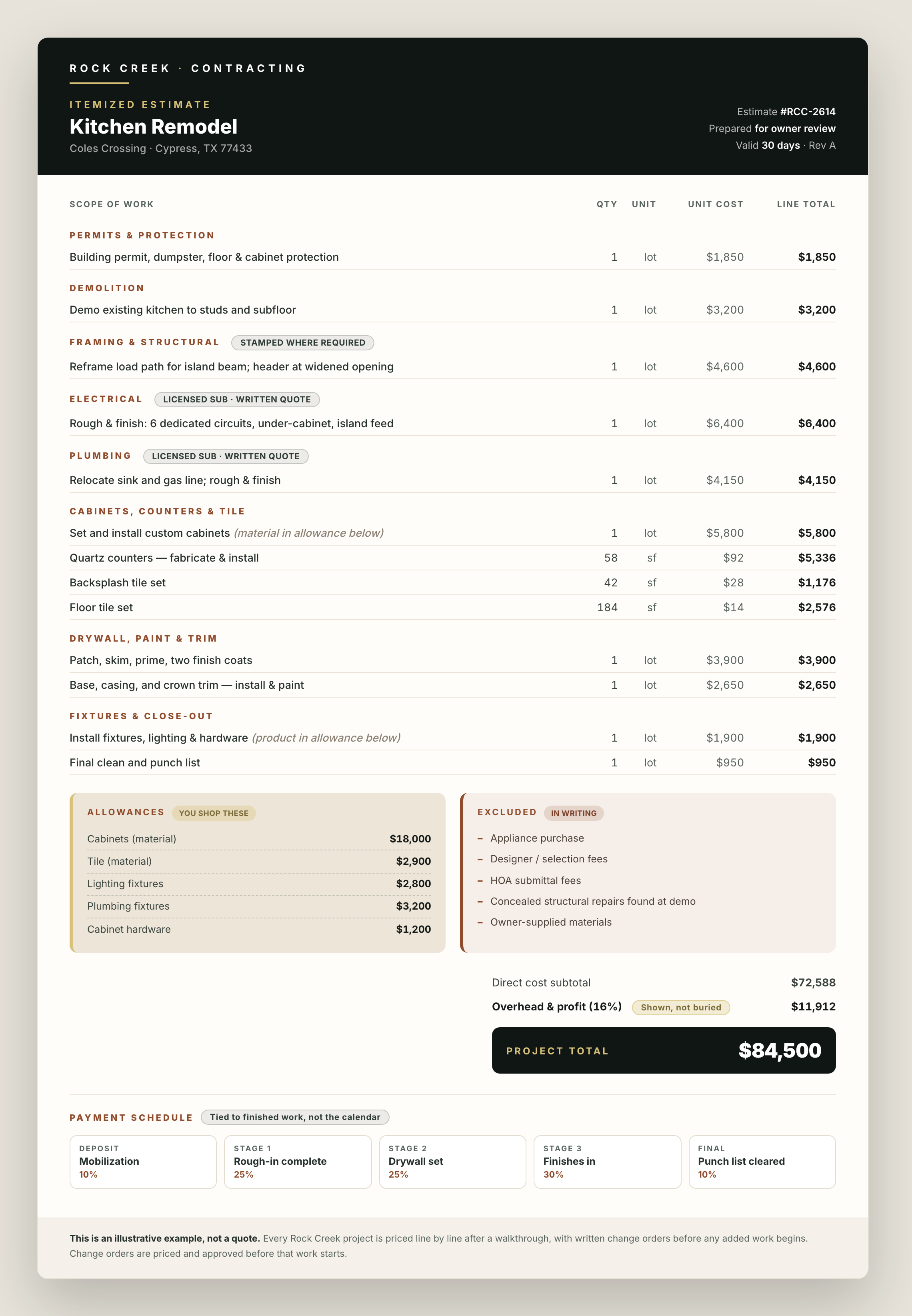
A one-line quote can feel simple. "Kitchen remodel: $84,500" is easy to read. It is also hard to compare, hard to audit, and hard to defend when the price changes later.
In Cypress and NW Houston, the same project title can describe very different scopes. A kitchen update in Coles Crossing, a primary suite renovation in Stone Gate, and a builder-grade upgrade in Bridgeland may all sound straightforward until cabinet lead time, structural work, finish selections, and trade availability show up in the estimate.
Estimate vs. quote
A quote tells you the number. An estimate tells you how the number was built.
One-line quote
"Kitchen remodel: $84,500"
- No scope you can compare
- Allowances hidden inside the price
- Markup buried in the labor lines
- Nothing ties payments to progress
Itemized estimate
Same $84,500, fully broken down
- Line items grouped by trade
- Allowances listed so you can shop them
- Overhead and profit shown plainly
- Payments tied to finished work
For small repairs, a quote may be enough. For a high-end residential project, addition, reconstruction, commercial buildout, or concrete/foundation scope, you want the estimate. That is the document you can use to compare bids, ask smarter questions, and hold the project to the scope you approved.
What each line item should tell you
1. The section of work
The estimate should be grouped in the order the build actually happens: permits, demolition, framing, rough trades, drywall, cabinets, counters, tile, flooring, paint, trim, fixtures, hardware, cleanup, allowances, and exclusions.
If the entire scope is compressed into one line per room, you cannot see the work. You can only see the price.
2. Quantity and unit cost
Look for square feet, linear feet, each, sets, days, or other measurable quantities. A line that says "tile floor: 84 square feet at material and labor rates" is more useful than "tile work: $1,800."
Visible math helps you compare bids. It also helps you see whether one contractor priced the whole room while another priced only the visible finish.
3. Labor and material split
Not every line needs a dissertation, but major categories should make clear what is labor, what is material, and what is supplied by the owner. This matters most for fixtures, cabinets, counters, flooring, lighting, and specialty items.
If you are supplying a product yourself, the estimate should say so. Otherwise both sides may think the other side owns it.
4. Cost codes or category tracking
Cost codes are how a contractor tracks the project against budget. The exact code system matters less than the fact that the estimate can be tracked by category once work begins.
When the estimate has no structure, the project usually has no financial tracking structure either.
5. Written trade quotes behind specialty scopes
Electrical, plumbing, HVAC, structural, concrete, foundation, glass, and specialty fabrication lines should be backed by a real trade number, not a guess. You do not need every vendor invoice before signing, but you should know whether the estimate is based on written quotes or assumptions.
Assumptions are allowed. Hidden assumptions are not.
6. Markup shown plainly
Contractors have overhead and profit. That is normal. The cleaner estimate shows the markup instead of hiding it inside inflated labor or material lines.
Transparent markup makes bids easier to compare. It also makes change orders less mysterious because both sides know how the added work is priced.
7. Allowances separated from fixed scope
An allowance is money set aside for something not fully selected yet, such as fixtures, tile, cabinet hardware, appliances, or lighting. It should be called out separately and tied to a written change-order rule if the final selection exceeds the allowance.
Low allowances can make a bid look cheaper than it really is. Read them carefully and compare them against products you would actually choose.
8. Specific exclusions
Exclusions should name what is not included: appliance purchase, designer fees, HOA fees, concealed structural repairs, utility upgrades, special access work, or owner-supplied materials. "Anything not listed" is not enough for a serious project.
A good exclusions section is not the contractor dodging responsibility. It is both sides agreeing where the scope stops.
9. Milestone payments
The payment schedule should connect to completed work, not just calendar dates. Mobilization, material delivery, rough-in, drywall, finishes, and punch-list close are stronger anchors than "payment due every two weeks."
The final payment should wait until the close-out standard is met.
10. Written change-order rules
The estimate or contract should say that changes are written, priced, and approved before the changed work starts. If a field condition changes the scope, the contractor should document the condition and price the change before proceeding.
"We will figure it out at the end" is not a change-order process.
How Rock Creek runs this
Rock Creek builds estimates as project-control documents: itemized scope, visible quantities, trade categories, written assumptions, separate allowances, specific exclusions, milestone payments, and written change orders.
The point is not to make the paperwork impressive. The point is to give the homeowner and the field team the same source of truth before the first workday.
Send the estimate question early
If you are comparing bids in Cypress, Bridgeland, Tomball, Cy-Fair, Towne Lake, or NW Houston, ask each contractor for the same thing: "Can you send an itemized estimate with allowances, exclusions, and change-order rules shown clearly?"
Call (281) 217-7620 or request a walkthrough. Rock Creek will walk the project, document the scope, and put the estimate in writing before you owe anything.